Enterprise AI
Observability for AI Clusters
Keep AI clusters at peak utilization with packet observability.



Keep AI clusters at peak utilization with packet observability.
Enterprise AI clusters are increasingly valuable, but expensive to build and operate. With fixed infrastructure costs, the economics depend on high sustained utilization – operators typically target 70 to 80 percent.
Gray failures, or fail-slow failures, are a significant part of the utilization gap. The cluster keeps working, but in a deteriorated state – stalled sockets, packet drops well below line rate, and jobs missing their latency objectives. These conditions persist because they are hard to diagnose. They straddle multiple subsystems – switches, NICs, kernels, storage, Kubernetes, the inference library – and the layers between software and hardware.




Packet evidence shortens root cause from days to hours to minutes, returning GPU time to the business and protecting ROI.

Packet data is immutable and kept outside the systems under attack, enabling credible forensics and defensible proof for compliance audits.

Confirms the running configuration hasn't drifted from the design, and that new design patterns deliver their intended results in production.

Optical taps and high-density cVu packet brokers (built on NVIDIA switches) are a cost-effective way to acquire and deliver traffic on the key interfaces between GPU clusters and users, management, and storage. By adding hardware timestamping and burst analytics at those monitoring points, gray failures can be correlated across the cluster edge. Inside the cluster, cTap-V exports packet data via eBPF with minimal CPU, memory, and network impact.
cStor capture appliances turn that traffic into evidence. A single unit, analyzing up to 200 Gbps, examines every TCP session across a 256-GPU cluster, cutting root cause time and MTTR. The cClear Control Center centralizes those metrics with GPU and switch telemetry for single-pane-of-glass observability.





Boundary taps at user, management, and storage interfaces target where gray failures actually surface, keeping instrumentation cost proportional to what's at stake.
Packet truncation and traffic prioritization keep mirrored data lightweight, so overhead on GPU hosts stays fixed by design instead of growing with cluster traffic.
Examining every session and transaction – not a sampled subset – gives compliance teams and operators a defensible record they can trust under audit.
cPacket AI makes packet-derived evidence accessible and explainable to shorten investigations.
The operator simply asks, “Why did P95 inference latency drop last week?” cPacket AI answers from evidence – correlating hardware-timestamped measurements, burst analytics, session and transaction metrics, and GPU/switch telemetry across the cluster. It names likely root causes, when and where they occurred, and the data behind them.
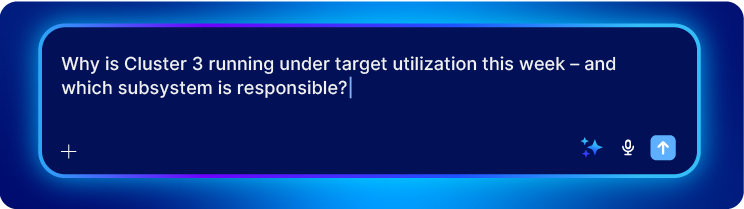

Ask a question instead of building a query or interpreting a dashboard, which saves time and resources.
Failures spanning switch, NIC, kernel, storage, and library get pinned to their actual source, ending finger-pointing between teams.
Reasoning built on every session and transaction, not a sample, means the answer holds up under scrutiny – no chasing false leads.
Get answers to common questions about network observability and cPacket solutions.
Sub-system telemetry is not sufficient for detecting gray failures. Gray failures happen when configuration between subsystems drifts or unforeseen failures such as an MTU inconsistency, too many open concurrent requests, etc. Telemetry can look healthy while the some jobs take too long or with a high latency. Packet-derived data measures the connections between entities, which is the part component telemetry structurally cannot see.
Not to get value, and the economics depend on scale. At enterprise scale while optical tap at the rail or spine layer gives direct, sub-millisecond burst attribution, these aren’t the key issues that cause performance deterioration for inference. Most enterprise clusters start at the boundary interfaces to users, management, and storage, and add back-end coverage where the workload justifies it.
cTap-V is an eBPF-based virtual tap which requires a very low CPU footprint, it is designed to minimize the overhead of the mirrored packets. It truncates packets and keep headers only, which with jumbo frames leads to 1:35 up 1:70 reduction in traffic. The mirrored data is assigned a priority so it never competes with the production traffic. Overhead on CPU, memory, and network capacity is bounded by design rather than left to scale with cluster traffic.
With the density of cVu AG and the performance of cStor S, you can get full coverage of packet-data with a single cStorS and a couple of cVuAGs, to monitor up to 128 GPUs cluster, and good enough for 256 GPUs.
Packets stay where they were captured and the derived metrics stay in cClear. Inference runs against the model and tenant the organization has already approved, inside its own perimeter, so the workflow inherits the security and regulatory posture that is already in place instead of introducing a new one to defend. cPacket AI covers detection and analysis.
Both work, but designing it in is more cost effective. Tap points, cabling that accommodates passive capture, and rack space at the observation points are best done during the design phase and can be more expensive once cabling and rack space are committed. The best time to design it in is during the build. The second best time is before the first major incident.
Our team of experts can work with you to align your network strategy to cPacket’s industry-leading packet broker and capture solutions.