SOLUTIONS
Network Observability
Prove what happened, where, when, and why with packet evidence.



Prove what happened, where, when, and why with packet evidence.
Faster speeds, hybrid complexity, and AI workloads are pushing network teams and tools to their limits. More traffic means more telemetry, alerts, and dashboards. Yet when an application slows or connectivity goes down, teams still struggle to explain what happened – and why.
Most monitoring relies on device-reported metrics, sampled flows, and averaged polling intervals. Each component reports its own health, while gray failures happen quietly in the traffic between them – like a microburst hidden in a five-minute average.
Blind spots widen as workloads move to cloud and Kubernetes environments, where physical taps can’t reach and native telemetry varies by provider.
Tool sprawl compounds the problem. Teams work from their own partial view, so engineers hop between dashboards, dispute ownership, and wait for the few experts who can read packets.




Ensure business continuity and high-quality customer experiences by detecting gray failures and degradations before they cause major disruptions.

Preserve traceable investigation paths and forensic evidence for compliance reviews and defensible reporting in highly regulated businesses.

Reduce MTTI and MTTR by using packet-derived evidence to quickly pinpoint what failed, where and when – and AI-assisted workflows to find out why.

Get more value from existing investments by extending packet intelligence across teams, tools, and workflows.

cVu packet brokers acquire traffic from optical taps, SPANs, and cloud mirroring, and cStor appliances capture and perform Layer 7 (L7) session analytics in the same device.
cClear Control Center correlates the resulting metrics by service and monitoring point, so engineers move from a dashboard to a session to the exact packets behind a symptom.
Physical and virtual deployments, plus cTap-V for Kubernetes, extend the same analysis across hybrid environments, while open APIs share packet evidence with the SIEM, ITSM, and observability tools teams already use.
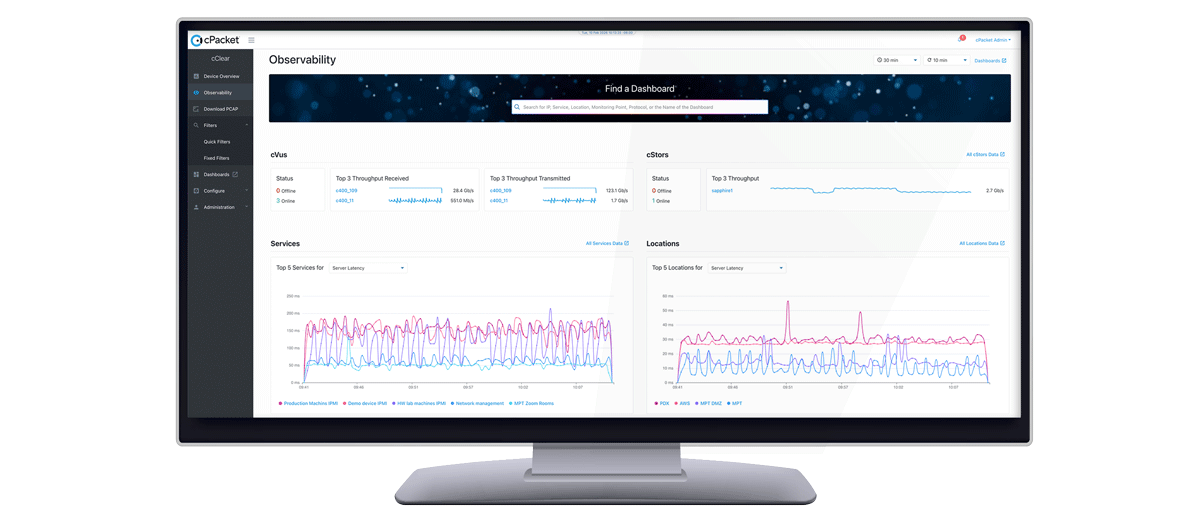




cStor simultaneously records packets while producing L7 session metrics for TCP, DNS, HTTPS, LDAP, SIP, and RTP, so every metric traces back to packet evidence.
Compare latency, retransmissions, and errors at each monitoring point along a path to isolate whether the client, WAN, load balancer, or server is at fault.
cBurst analyzes traffic at 1-millisecond resolution over nanosecond-accurate timestamps, identifying which source IPs and applications caused a burst that five-minute averages hide.
cPacket applies AI-guided investigations and embedded troubleshooting skills to packet and session data across monitoring points. Using existing AI tools, engineers and application teams can ask questions in plain language to identify root causes and verify findings with packet evidence.
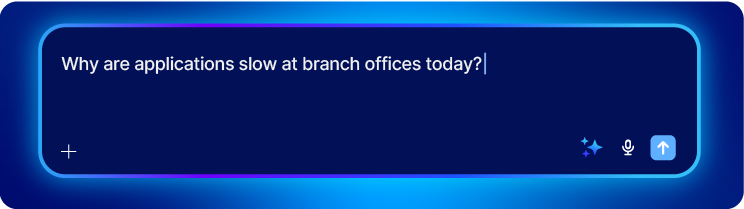

Purpose-built MCP servers let your LLM or agent query cClear and cStor data, so engineers ask operational questions and get answers backed by network evidence.
Pre-validated skills encode cPacket data semantics, tested queries, and investigation methods, so application teams and Level 1 engineers can investigate before escalating.
Each finding ties back to the queries and packet data behind it. cPacket AI covers detection and analysis, while remediation stays with your engineers.
Get answers to common questions about network observability and cPacket solutions.
Packets are the only record of what actually happened on the wire – not sampled or abstracted. Packet data catches granular details that reveal what other tools miss and provides indisputable evidence that stands up to operational and compliance scrutiny.
cPacket network observability solutions integrate with existing SIEM, SOAR, and ITSM tools to deliver packet-level evidence about the traffic that they would otherwise miss.
cPacket’s network observability platform provides 360-degree visibility across complex, hybrid networks. We offer physical appliances for on-premises networks and virtual appliances for public and private clouds, with a lightweight eBPF-based tap for Kubernetes.
Our team of experts can work with you to align your network strategy to cPacket’s industry-leading packet broker and capture solutions.