SOLUTIONS
Hybrid Network Monitoring
See your entire hybrid network in high definition.



See your entire hybrid network in high definition.
Maintaining the health, performance, and security of on-prem networks is hard enough. Today’s mission-critical services flow across a labyrinth of data centers, colocation facilities, and private and public clouds – which are challenging to tap.
Each environment has its own operators, monitoring tools, and data formats – and every CSP offers different mirroring services. The result is fragmented data and blind spots at exactly the boundaries where problems hide.
When a service shuts down, network, cloud, and security teams compare separate dashboards while resolution time grows and administrative overhead adds up.




Run the same software, interfaces, and workflows in every environment, so you can troubleshoot issues and validate changes with shared packet evidence on a single pane of glass.

Pinpoint whether retransmissions, latency, or connection failures originated on-prem, in the cloud, or in between – without stitching together data from separate tools.

Avoid paying for parallel mirroring sessions and duplicative cloud-only tools by running one visibility platform across data center and cloud.

Deliver continuous packet feeds to NDR, XDR, and SIEM tools so cloud workloads meet the same security standard as the data center.

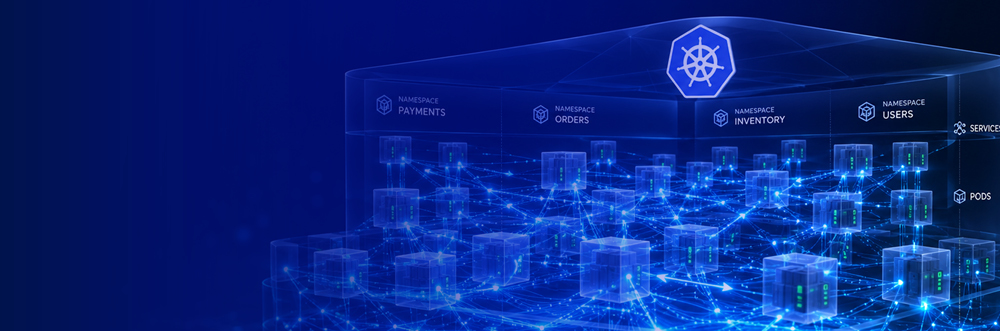
cPacket’s Unified Network Observability Platform offers physical appliances for on-premises infrastructure and agentless virtual appliances for private, public, and multi-cloud environments, as well as virtual smart taps for containerized workloads.
cVu packet brokers collect copies of network traffic from on-premises taps and cloud mirroring services, then filter and send each tool only the traffic it needs. cStor packet capture appliances store and analyze that traffic in every environment, turning it into performance metrics. A single cClear console brings those metrics together so teams can trace a problem across data center and cloud.
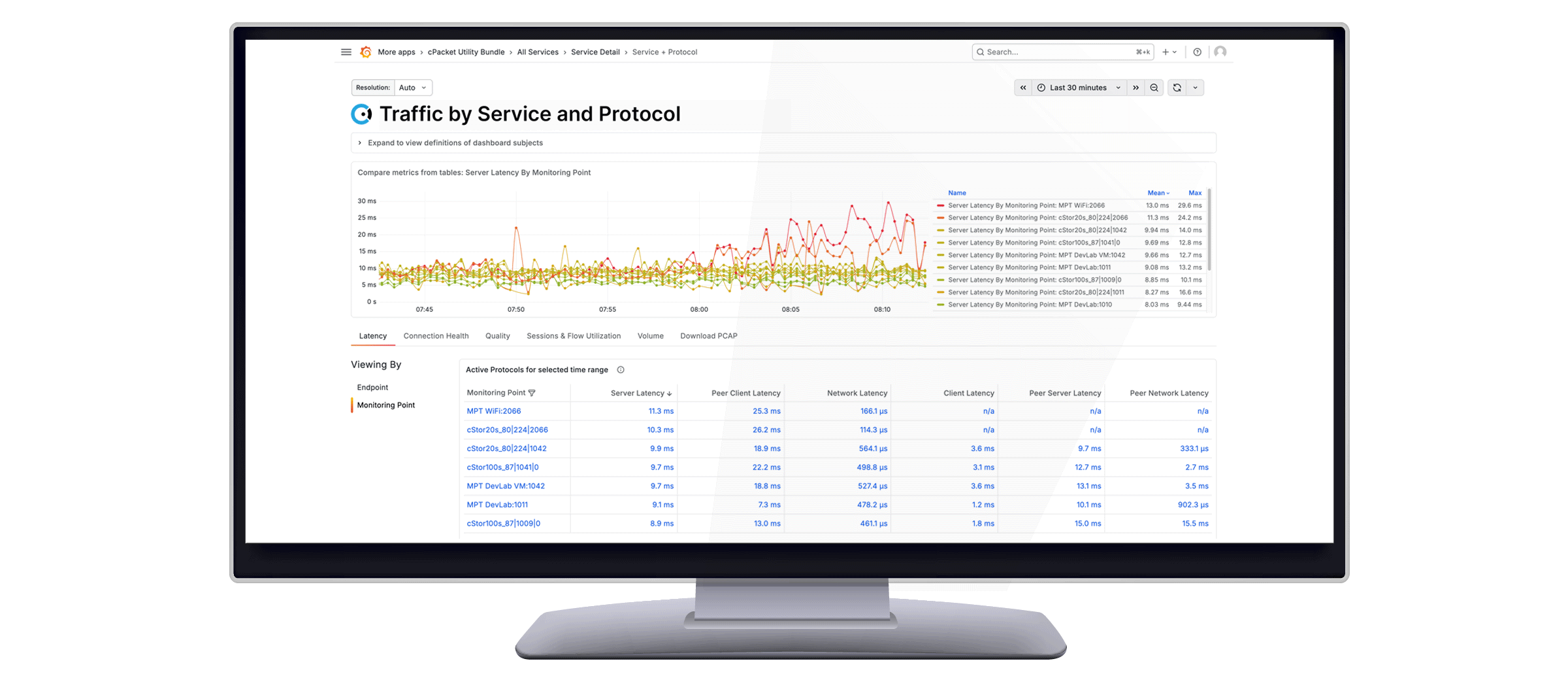

cVu-V decapsulates, filters, and replicates mirrored cloud traffic to multiple destinations, and auto-scales behind cloud load balancers as traffic changes in AWS, Azure, and Google Cloud.
cStor and cStor-V capture and analyze packets with the same software, so a problem looks the same whether it starts in a rack or a VPC.
cClear views physical and virtual cStor data by service, location, and monitoring point, and builds a single unified PCAP download from every cStor with one filter.
CPACKET AI SOLUTION
cPacket AI simplifies and accelerates root cause investigations across hybrid environments. Engineers prompt their LLM with a service, symptoms, and time window, which triggers the system to access packet metadata stored on cClear Control Center using an MCP server. Root cause and recommendations are returned quickly by the LLM – guided by cPacket's troubleshooting methodology encoded as skills, and grounded in verifiable packet evidence from every environment.
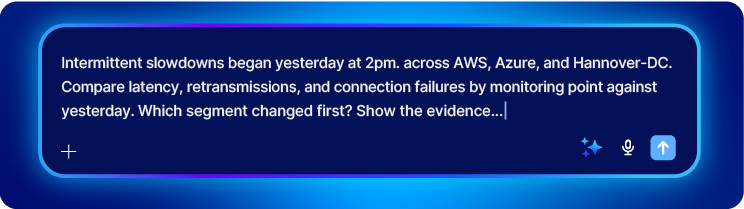

MCP servers connect your AI client to the cClear Control Center, so engineers can ask about latency or failures anywhere in the hybrid network and get answers from packet data.
Packaged data semantics, tested query patterns, and troubleshooting methods guide the model through the same steps that senior engineers follow, improving accurate and consistent outcomes.
Purpose-built MCP interfaces connect to the AI clients and orchestration platforms your organization already runs, bringing hybrid network evidence into existing workflows.
Get answers to common questions about network observability and cPacket solutions.
cPacket offers physical observability appliances for data centers and colocation facilities and virtual appliances that run in AWS, Microsoft Azure, Google Cloud, and VMware ESXi environments. For container workloads, AWS Elastic Kubernetes Service (EKS) is currently supported.
cPacket's Control Center runs as a physical appliance or in popular cloud environments, so you can see packet data and manage cPacket devices across your hybrid estate.
cPacket’s virtual appliances typically handle ~10Gbps per instance and can scale out horizontally behind a load balancer while leveraging native CSP autoscaling methodologies to handle variable cloud traffic workloads.
cPacket extends native cloud monitoring with packet-level session KPIs and delivers filtered, replicated packet feeds to NDR, XDR, SIEM, NPM, and APM tools. cPacket supports integration with native CSP traffic mirroring services.
cPacket is an official launch partner for Google Cloud Network Security Integration and supports both out-of-band packet mirroring and in-band inspection.
Our team of experts can work with you to align your network strategy to cPacket’s industry-leading packet broker and capture solutions.