SOLUTIONS
Security Monitoring
Watch live traffic for threats that attackers can't hide



Watch live traffic for threats that attackers can't hide
Enterprise SOCs rely on logs, endpoint agents, and configuration audits that describe what systems should be doing. Skilled attackers with valid credentials can operate inside a fully compliant configuration and disable or alter the logs that would expose them. Security vulnerabilities hide the same way. Deprecated TLS versions, expiring certificates, and clear text LDAP can persist in live traffic – even after a configuration audit passes.
Hybrid estates widen the gap. East-west, cloud, and acquired-network traffic creates blind spots teams may not know exist. When an alert fires or a CVE drops, analysts need to know what was exposed, what it talked to, and whether the exposure was exercised.
Too often, that evidence was never collected or has already expired. For regulated enterprises in finance, healthcare, and the military, the result is slower containment, conclusions the team can't prove, and audit findings that are hard to defend.




Find scanning, C2 beaconing, exfiltration attempts, and weak encryption in observed traffic, including activity that host-based tools miss.

Establish which systems were exposed, trace communication, and determine if vulnerabilities were exploited, so containment starts sooner.

Back findings and compliance reports with packet evidence captured independently of the systems under investigation.

Deliver filtered, deduplicated traffic to IDS, NDR, and DLP tools so they can inspect what matters without adding more tools.

Optical taps and SPANs feed packets to cVu packet brokers, which deduplicate, filter, and slice traffic at line rate before delivering them to security tools.
cStor appliances captures every packet while analysts query and retrieve them – extracting DNS, TLS, LDAP, and TCP session analytics along the way.
cClear Control Center queries all cPacket devices to provide real-time visibility of traffic spanning on-premises, co-location, virtual, and cloud environments. When a tool alerts or a threat escapes detection, analysts retrieve the exact packets with indexed search instead of scanning hours of capture.




FPGA or ASIC on every cVu NG port runs deduplication, filtering, and slicing concurrently at line rate, with 100% packet accountability and no throughput cliff.
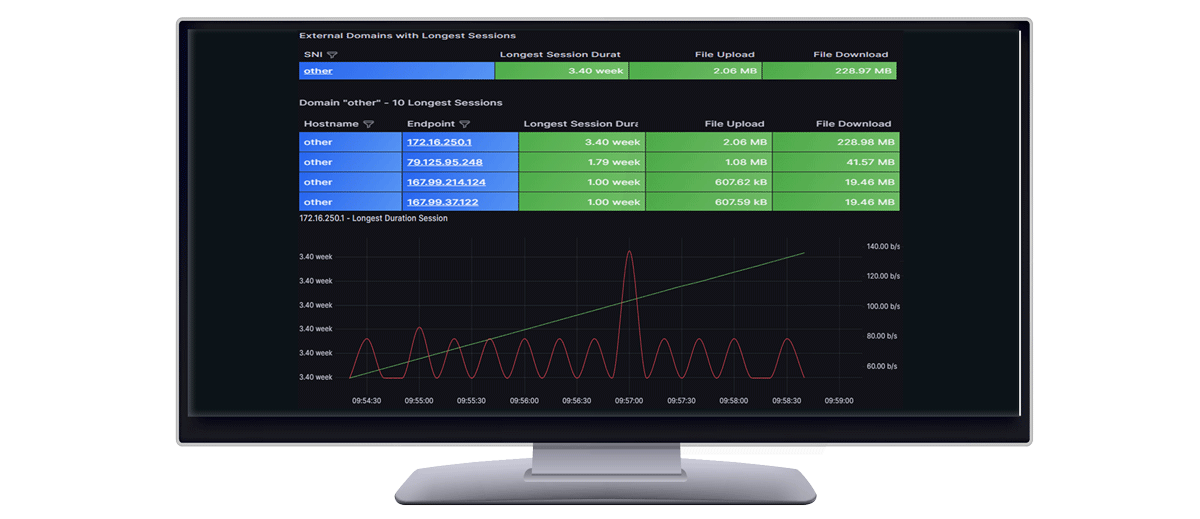
cStor records packets at up to 200 Gbps while producing DNS, TLS, LDAP, and TCP metrics that expose certificate posture, cleartext protocols, and unusual connections.
CPF indexing skips capture blocks without the target IPs, ports, or VLANs, so pulling a few suspect sessions from hours of capture scales with the answer, not the window.
cPacket’s AI-guided workflows close that gap. SOC engineers can ask plain language questions in their existing AI client, which then queries session analytics and packets from cPacket appliances via purpose-built MCP servers.
cPacket AI uses encoded security skills to reason over the packet data – applying tested methods for finding scanning, C2 beaconing, DNS abuse, exfiltration, and TLS or LDAP compliance gaps. Each finding traces back to the underlying sessions and packets, so engineers can verify the evidence before acting while response stays with your team.
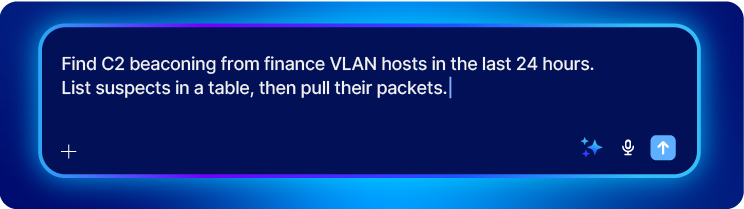

Follows the same methods that experienced packet analysts use to hunt for threats and compliance gaps, so every SecOps analyst can get the same results.
Pre-built MCP queries retrieve the session records and packets behind each finding, so engineers verify results without writing capture filters or query syntax.
cPacket AI detects and analyzes; containment and remediation stay with your engineers, so AI never takes an unreviewed action on business-critical services.
Get answers to common questions about network observability and cPacket solutions.
cPacket feeds security tools clean, deduplicated packet data and captures the same traffic for forensic retrieval, enhancing the existing security stack rather than replacing it.
Packets are captured from the network itself, external to the hosts and agents being monitored, and immutable once on the wire
cVu packet brokers send copies of the packets to the security tools AND packet capture appliances, so both tools get the same data at the same time to use during investigations.
cPacket does not decrypt TLS sessions. cStor analyzes handshake metadata to expose deprecated versions, weak ciphers, and expiring certificates. cVu dynamic slicing strips encrypted payload while keeping headers and the TLS handshake, and 10G and 40G cVu NG models can decrypt MACsec at the link layer.
cStor packet capture appliances let you restrict each user group to headers only, masked packets, or raw packets. Masking policies redact payload at download time once configured with cPacket support.
Our team of experts can work with you to align your network strategy to cPacket’s industry-leading packet broker and capture solutions.