SOLUTIONS
Data Exfiltration
Early detection is the first step to containment



Early detection is the first step to containment
A steady, high-volume data stream to an external endpoint is easy to miss unless someone measures the volume, duration, and destination for every session in every environment.
Hybrid and multi-cloud networks give attackers more places to work unseen. Data moves between on-prem data centers, co-location facilities, and cloud providers – each with its own tools and blind spots. Without consistent visibility, teams detect too late, struggle to scope what was taken, and leave the door open for future breaches.
Meanwhile, dwell times linger, more customer PII is compromised, business disruption worsens, and regulatory exposure increases.




Flag sustained, high-volume transfers to external endpoints while the session is still open – not after the data is gone.

Know which server was targeted, which client pulled the data, how much was exfiltrated, for how long, and over which protocol.

Retrieve the original packets for forensic analysis, legal holds, and compliance audits – independent from logs that can be tampered with.

Route exfiltration alerts to the dashboards, incident tools, and notification channels your NOC and SOC already use.

cVu packet brokers deliver lossless, deduplicated ingress and egress traffic from on-premises, colocation, virtual, and multi-cloud environments to cStor appliances, which capture both directions and characterizes each client-server session at line rate.
cClear Control Center brings every environment into a single view and alerts your incident tools when a session's running total crosses a threshold you set. Analysts download the PCAP, identify the client, server, and protocol, and close the security hole.
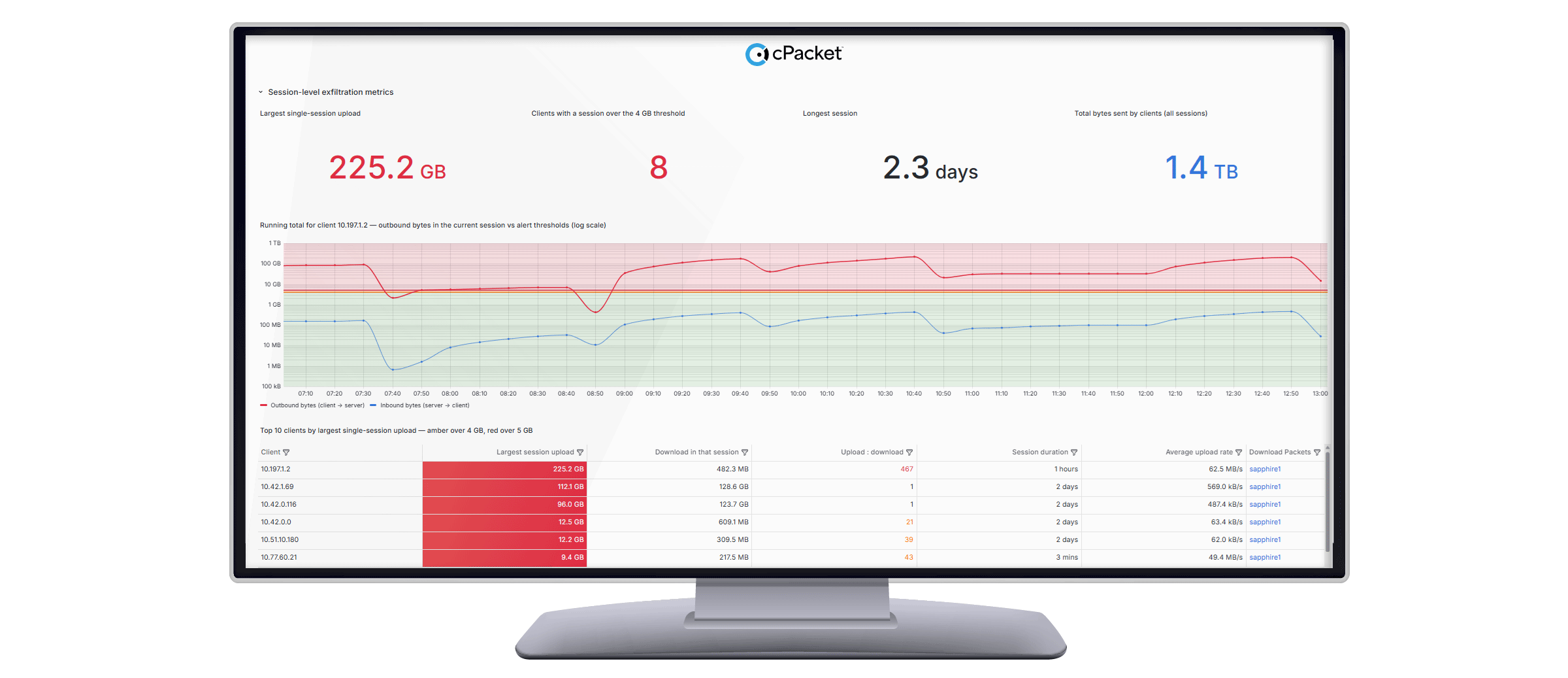



Measures ingress and egress traffic for every client-server session – bytes, duration, bandwidth, and a running total – so large outbound transfers stand out from normal activity.
Set volume thresholds, such as 5 GB per session. cClear notifies its dashboard, email, text, Datadog, or ServiceNow as soon as a session exceeds them.
Investigators can query and retrieve the exact packets they need – while cStore appliances continue recording and analyzing every packet at up to 200 Gbps.
cPacket MCP servers expose cStor session analytics and enriched cClear data to the LLM your organization already uses. Ask it to find exfiltration between internal servers and external clients, and it analyzes ingress and egress session volume, duration, and destinations across the network to return every matching condition.
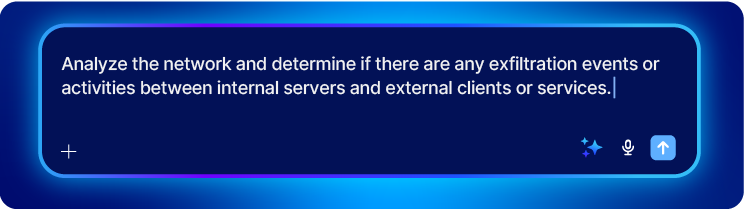

Ask the LLM to check for exfiltration and get back the internal servers, external endpoints, and transfer volumes involved – without writing queries or building dashboards.
The model reasons over session metrics derived from lossless packet capture, so every finding traces back to wire-level evidence your team can verify.
cPacket MCP servers ship today and connect to your existing AI platform while network telemetry stays inside your environment.
Get answers to common questions about network observability and cPacket solutions.
Data exfiltration is the unauthorized transfer of data from enterprise-controlled systems. It may occur through direct file transfer, cloud-to-cloud synchronization, abuse of legitimate collaboration tools, database export, APIs, remote-access tooling, or compromised third parties.
cPacket complements your security stack by making them run more efficiently. cVu feeds deduplicated, filtered traffic to NDR, IDS, and SIEM tools, while cStor adds session analytics and lossless capture for detection and forensics.
For volume-based exfiltration patterns, cPacket can help teams detect movement of encrypted data. Detection relies on session metadata – bytes, duration, bandwidth, and endpoints – that remains visible without decrypting payloads.
cPacket’s observability solutions provide a 360-degree, packet-level view across network segments. We offer physical appliances for on-prem deployments and agentless solutions for virtualized and cloud environments.
cClear sends notifications to its dashboard, email, text, and third-party platforms such as Datadog and ServiceNow. Analysts can open the incident and download the PCAP to investigate.
Our team of experts can work with you to align your network strategy to cPacket’s industry-leading packet broker and capture solutions.