Enterprise AI
AI Agent Discovery
Inventory the AI agents running on your network.



Inventory the AI agents running on your network.
AI agents are proliferating enterprise networks – embedded in tools, spawned on demand by automation platforms, and deployed by employees to speed up workflows. They break traditional IT norms, in which applications are deliberately deployed and inventoried.
Even sanctioned agents can inadvertently violate security policies, trigger data leaks, or disrupt operations. They work fast and autonomously as they gather information from devices and applications.
Monitoring shadow agents challenges many network operations teams. Logs, metrics, and traces report changes in device state. But when agents choose their paths at runtime, evidence of their behavior lives in the traffic in between.
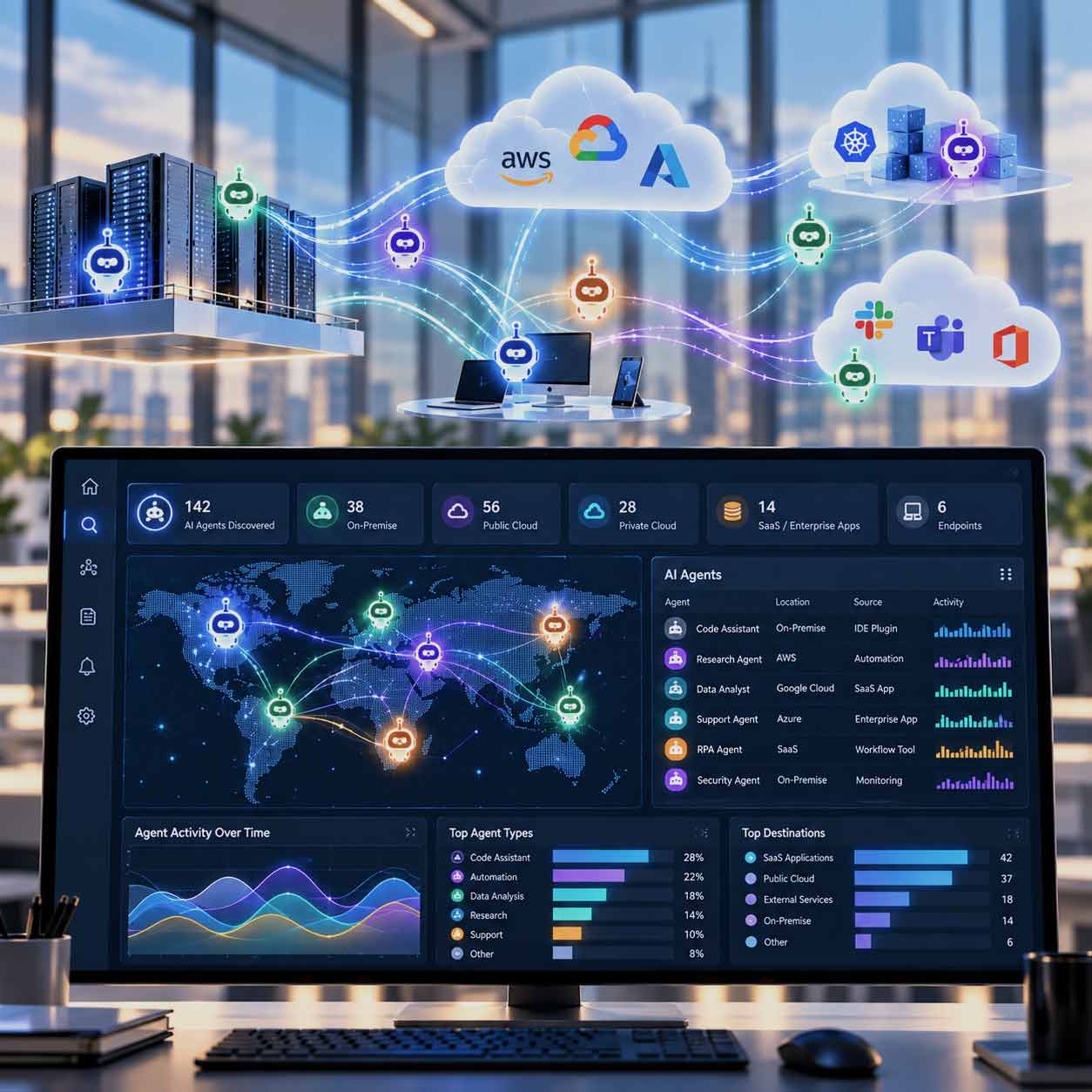



Discover every AI conversation from the traffic, rather than relying on change-records or deploying system agents on every device.

Catch query floods and retry storms from well-intentioned agents before they degrade a production service.

Verify actual LLM usage against vendor token reports by measuring consumption with data crossing the network.

Each scan reports the agents that are new since the last one, so the team reviews a delta instead of the same list.

cVu packet brokers acquire traffic out of band across on-premises, virtual, cloud, and Kubernetes environments and deliver it to cStor capture appliances, which turn packets into session records (DNS queries, TLS server names, ports, and byte, packet, and session counts by direction). The cClear Control Center organizes those records by service and location.
The inventory and LLM usage data come from the tool endpoints that host actual queries – public model APIs and LLM endpoints. Passive packet acquisition eliminates the need for additional instrumentation or software at the endpoint – making this approach ideal for OT estates and appliances where agents can't be installed.
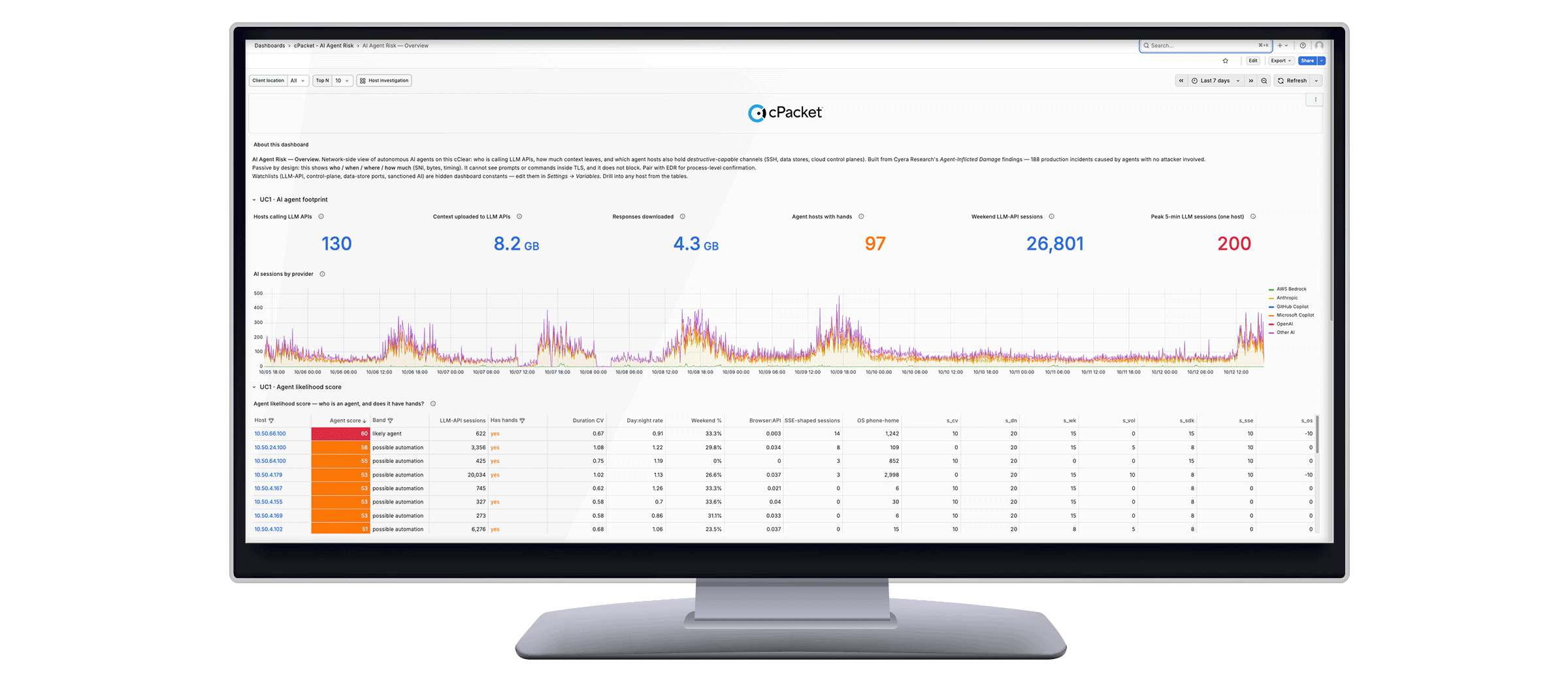




Packet-derived inventory needs no SDK, no code change, and no host software. It sees agents whether or not they cooperate with your instrumentation.
Agents are identified by the model and tool endpoints they query, using DNS and TLS server names extracted by the cPacket appliances. Encrypted traffic stays encrypted.
Bytes, sessions, and direction per endpoint give an independent measure of LLM consumption, per service and per location.
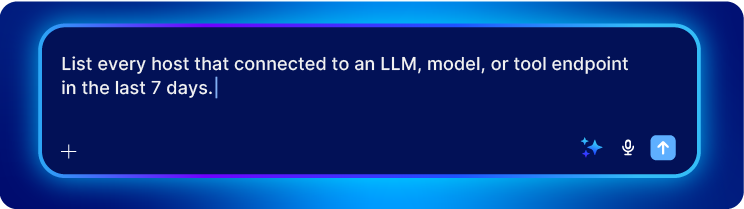
cPacket AI brings the same session data into your own AI client through cPacket MCP servers and encoded skills, so operators can ask in plain language which hosts talk to model endpoints or which agent's query rate jumped.
The purpose-built skill pack classifies each flow on two axes: whether the caller is a person or an automated agent, and whether the destination is a model, a tool, or another agent. Classification uses flow metadata, destination names, ports, and behavioral signals rather than payload, so it works on encrypted traffic.

Heuristics built on cPacket's L7 session data separate user, assistant, and agent traffic, and tell model calls apart from tool calls and agent-to-agent calls.
The assistant holds the operator's decisions, so every scan reports the delta: the new agents, not the known ones.
Long-horizon baselines flag when an agent's volume, fan-out, or retry behavior moves outside its normal range.
Get answers to common questions about network observability and cPacket solutions.
Network engineers can find shadow AI agents by monitoring the record created as they cross the network – touching endpoints along the way.
With cPacket, you can discover encrypted agent traffic. Classification uses flow metadata, DNS and TLS server names, ports, and timing and volume behavior. Where traffic is unencrypted, the wire format can be decoded to corroborate.
Passive packet acquisition through cVu packet brokers eliminates the need to install software on each endpoint. That makes it usable in OT environments and on systems where host software isn't an option.
cPacket can measure LLM usage via network data – bytes, sessions, and direction per model endpoint, broken out by service and location. It is an independent check on what the provider bills.
Operators, not inference models, determine what constitutes a rogue agent – assigning agents as allowed, blocked, or awaiting-decision. Anything observed that isn't allowed is rogue.
Our team of experts can work with you to align your network strategy to cPacket’s industry-leading packet broker and capture solutions.