

Agentic AI and the Future of IT Operations
Early Takeaways from cPacket's MCP Journey
By Ron Nevo, Chief Technology Officer, cPacket Networks
Late last year, cPacket Networks introduced our Model Context Protocol (MCP) servers to early adopter customers, providing access to our curated packet analytics metrics in cClear and AI-powered network insights from the cPacket Insight Engine. Since then, I've had the opportunity to observe firsthand how customers are using MCPs in the field — and what I've learned has reinforced my conviction about the future of IT operations.
I want to share those insights here, because MCP is a step in the AI journey, not the destination. What we're really building toward — and what I believe represents a transformative inflection point for IT operations — is the broader vision of agentic AI.
Why Agentic AI Changes Everything
At the end of the day, what matters to IT operations (and specifically NetOps teams) is that applications work as expected and users have a consistent experience. When an application is slow, users don't care whether the root cause is in the network, the database, the code, or the cloud provider. They just want it fixed.
Agentic AI is a genuine revolution in IT operations, enabling much greater integration across systems and teams. But technology and tools alone do not deliver outcomes. Capturing the true value of agentic AI requires deliberate changes to the way organizations operate — how teams collaborate, how decisions are made, and how accountability is defined. Agentic AI expands the ceiling of what’s possible; organizational transformation determines whether that potential is reached.
Let me break down why I believe this is such a significant shift.
From Data to Wisdom: Climbing the DIKW Pyramid
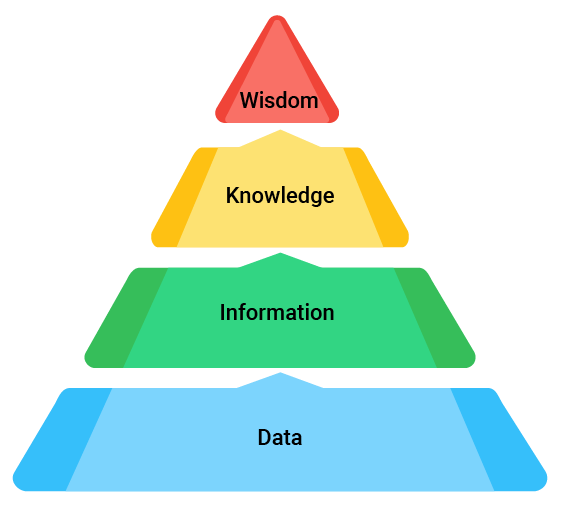
There's a classic framework in knowledge management called the DIKW pyramid: Data, Information, Knowledge, Wisdom. It's a useful lens for understanding what we're building at cPacket — and where agentic AI fits in.
Data sits at the base of the pyramid. For us, that's raw packets. Not sampled, not summarized. Every packet crossing your network is captured in real time – without loss – across on-premises data centers and cloud infrastructure. We're talking trillions of packets per day, preserved as the ground truth of what actually happened on your network. There's no substitute for it.
Information emerges when we process that packet data into something more concise and manageable. Our metrics and dashboards transform those trillions of packets into visualizations that reveal patterns and behaviors over hours, days, or weeks. Instead of staring at packet captures, you can see trends, spot anomalies, and understand what's changing in your environment. The complexity begins to become controllable and streamlined.
Knowledge is where things get interesting. By baselining, correlating across time and location, and recognizing patterns, we distill information into specific, actionable insights. We don’t just tell you that "TCP retransmissions increased," but that "retransmissions between your New York trading servers and the Chicago exchange spiked 340% starting at 9:31 AM, coinciding with the market open." Context transforms information into something that you can act upon.
This is where agentic AI fundamentally changes the game. Traditional monitoring tools present information and may generate alerts. But with agents, cPacket's observability platform becomes part of an organization's living knowledge base—not just a source of metrics, but an active participant in understanding, correlating, and explaining what's happening across your entire infrastructure.
Wisdom? That's still your job…. Today, cPacket-enabled agents observe, correlate, explain, and recommend. They do not push configuration changes, modify security policy, or suppress alerts without human approval. Action remains human-authorized by design. This is not a limitation — it is a guardrail.
Better Workflows, Faster Outcomes
The real promise of agentic AI isn't just smarter tools — it's fundamentally better workflows that lead to faster, more accurate outcomes. And better workflows start with better data integration.
For decades, one of the biggest pain points in IT operations has been bringing data together. Organizations would spend engineering years building ETL pipelines to combine packet metrics, audit logs, application telemetry, and other sources. The work was brittle, expensive, and never quite finished.
Agentic AI, built on open protocols like MCP, changes this equation. If tools expose open APIs and participate in the ecosystem, agentic AI significantly reduces the mechanical cost of integration. This dynamically combines information that exists in your environment – turning it into knowledge without massive engineering investments. cPacket is fully committed to this open ecosystem. We believe our value lies in providing the highest-quality observability data, not in locking customers into proprietary integrations.
Openness doesn't compromise security. Our MCP implementation keeps data within the customer's environment — packet metrics and insights are queried on demand, not exported to third-party AI services. Customers maintain full control over what data is accessed and by whom, with the same role-based access controls they already use. For regulated industries like financial services and healthcare, this architecture means you can leverage agentic AI workflows without creating new compliance risks.
Consider a typical incident investigation today. An alert fires. A Tier-3 engineer opens three dashboards, queries two logging systems, checks the change management database, and maybe pulls up a packet capture. They're mentally correlating across systems, trying to build a coherent picture. It works, but it's slow and error-prone.
Now consider the same investigation with agentic AI. The engineer asks: "What's causing latency for our payment processing service?" The agent queries packet metrics, correlates with recent changes, checks for related alerts, and synthesizes an answer: "Latency increased 47% following yesterday's firewall rule update. The new rules are causing asymmetric routing, resulting in TCP retransmissions." Time to root cause: seconds instead of hours.
The same workflow improvement applies to repetitive operational tasks — generating daily health reports, monitoring for expired certificates, watching for unintended configuration changes. These tasks are important but tedious, and they're exactly what agents can handle autonomously, freeing IT operations teams to focus on what actually matters: ensuring applications perform well and users stay happy.
A real-world example illustrates the power of this approach. Shortly after deploying our agent in customer’s environment, we asked it to review the overall health of the DNS infrastructure. The agent identified widespread DNS sprawl caused by several misconfigured Active Directory servers. As a result, the environment was querying thousands of external domain controllers. Following a simple configuration change to enforce proper forwarding, the number of external domain controllers contacted dropped to fewer than ten — and average application access latency fell from over 100 milliseconds to under 20 milliseconds. No new tools were added; the insight came from correlating packet-level DNS behavior with configuration context.
The Four Ws: What Packets Tell Us

Packet data answers the fundamental questions that matter when something goes wrong: What happened? Where did it happen? When did it happened? And critically, Who was involved?
Logs and other telemetry provide the Why. Packet observability data detects that an application started experiencing latency degradation at 2:47 PM. That's the What, When, and Where. But the application logs reveal that a configuration change was pushed at 2:45 PM. That's the Why.
Neither data source is complete alone. Together, they tell the full story. Agentic AI makes combining these sources natural and immediate.
Domain Expertise: Teaching LLMs to Think Like Network Engineers
Raw packet metrics are powerful, but they require expertise to interpret. What does a spike in TCP retransmissions really mean? How do you identify a routing loop from flow data? What patterns indicate a compromised host versus legitimate scanning?
This is where cPacket's investment in agentic AI goes beyond simply exposing data through MCP. We're embedding deep domain knowledge into our tools and system prompts, enabling users to ask high-level questions like "Give me a health report for our trading application" or "Are there any security vulnerabilities in our east-coast data center?" They don’t need understand the subtleties of DNS resolution timing, DHCP lease behavior, or TLS handshake anomalies.
The LLM becomes a well-informed colleague with the tribal knowledge of your specific network, not just a query interface. Augmenting a team’s expertise – not replacing it – is becoming increasingly important as more skilled networking experts retire and move up within organizations.
Personalization: The End of Alert Fatigue
Every IT operations professional knows the feeling: hundreds of alerts per day, most of which aren't relevant to your area of responsibility. The signal gets lost in the noise.
Agentic AI offers a different model. Agents learn and adapt to individual users. A security engineer sees different insights than a network engineer. An engineer responsible for New York doesn't need alerts about Singapore. The patterns that matter during a new system rollout differ from those during a maintenance window.
Through feedback loops and continuous learning, agents develop an understanding of what each user actually needs – similar to the way Spotify learns your music preferences.
The Road Ahead
cPacket's MCP servers were our first step on this journey, and what we've learned from customers in the field has only strengthened our commitment to the evolving agentic AI ecosystem.
We still work with customers to tighten the operational safeguards of agents, such as read-only access for agents, auditability of agent reasoning, and clear rollback paths when conclusions are wrong.
I like to think of cPacket's packet capture and analytics as the eyes and ears of an ITOps AI brain. We see everything that crosses the network, in full fidelity, across hybrid environments. We capture the data, transform it into information, and elevate it to knowledge through correlation and context. That visibility, combined with the workflow improvements that agentic AI enables, will help organizations ensure their applications run faster, more securely, and more smoothly — delivering the user experience their customers expect.
The future of IT operations isn't about more dashboards, more alerts, or more data. It's about the right insight, delivered to the right person, at the right time. It's about workflows that take seconds instead of hours. It's about climbing the pyramid from data to knowledge — and leaving the wisdom to the humans who know their business best.
That future is what we're building toward, and we're just getting started.